
success story

Anatomy of a Digital Failure: When Technical Debt Stifles Business Growth
Type
Emergency Team, Product and Service Industrialization
Year
2023 - Ongoing
success story
Emergency Team, Product and Service Industrialization
2023 - Ongoing
A leading recruitment firm engaged us to perform a deep technical audit of their proprietary platform. The objective was to identify mission-critical bottlenecks and architect a remediation roadmap for both immediate recovery and long-term scaling.
This application is the backbone of the client's core business, serving as the central ecosystem for their entire labor supply chain.
The portal orchestrates everything from talent acquisition and screening to automated contracting and full-cycle administrative management, providing the flexibility required to navigate the complexities of the staffing industry.
Our engagement began with a high-intensity Technical Due Diligence. Through extensive reverse engineering, we performed a comprehensive "health check" to assess the system's structural integrity.
The audit uncovered a staggering level of complexity: we inherited a legacy monolith completely lacking documentation and weighed down by massive technical debt. The issues ranged from fundamental architectural flaws to poor implementation choices. These weren't just "bugs"—they were systemic risks that compromised data security, system integrity, and overall maintainability.
With zero documentation available, the business had lost all visibility into how the current implementation actually mapped to its original functional requirements.
Operationally, the platform was effectively a black box. The client’s back-office team couldn't function autonomously, as daily workflows relied on manual "band-aid" fixes from the previous developers just to keep data aligned and processes moving.
Architecturally, the software suffered from extreme tight coupling with external services. Over-reliance on fragile asynchronous syncs made it impossible to trace data flows accurately, making diagnostics nearly impossible.
With business continuity at stake, we ruled out a "big bang" rewrite. Instead, we executed an incremental refactoring strategy to mitigate risk while delivering immediate operational value.
We leveraged core engineering principles—prioritizing simplicity and standardization—to replace brittle custom code with battle-tested industry patterns that ensure long-term stability.
The first phase was managed as a mission-critical emergency: the previous vendor had exited, leaving the client with a total system blackout.
Working directly from the source code, we radically simplified the architecture and migrated the entire stack to a new cloud provider. This decisive move allowed us to restore service and stabilize business operations in record time.
Once the system was stable, we partnered with the client to translate business needs into technical reality, systematically redesigning core workflows like onboarding and contracting. This deep refactoring modernized the user experience and optimized the tech core, resulting in clean, modular code with high observability.
Currently, our partnership moves forward on two fronts: while we continue to remediate secondary legacy flows, we are also building out new features to drive the business forward.
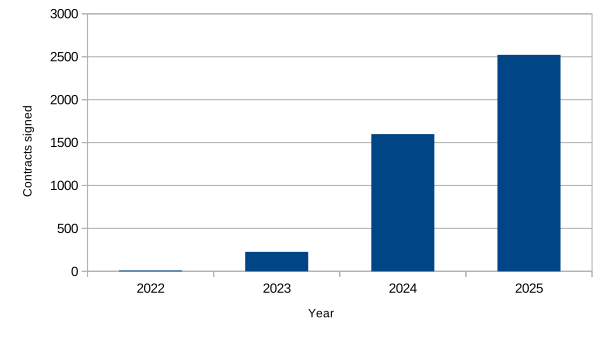




-94%
architectural complexity.
From 18 microservices to 1 modular monolith
+ years
ongoing
This recovery and modernization effort proves that effective software design isn't about the tech stack—it’s about how technologies are architected, governed, and evolved.
Without a solid foundation, maintainability decays at an exponential rate, eventually paralyzing business agility.
By stripping away complexity and rationalizing workflows, we delivered more than a working platform; we gave the client a strategic asset unburdened by technical debt.
The company now operates on a secure, scalable foundation that moves at the speed of business, turning a previous liability into a competitive advantage.